
What Brunswick County Property Tax Records Separate
The Commissioner of the Revenue assesses property. The office also maintains ownership and tax-map details, and it administers disabled-veteran relief. The Treasurer collects the tax and keeps ticket, balance, and payment-history information. These property records overlap, but they answer different questions. An assessed value says nothing about whether a bill was paid. A paid ticket says nothing about a later deed transfer. The comparison here sticks to functions the county itself describes for each office.
| Field | What It Shows | Where |
|---|---|---|
| Owner roll | Owner as of January 1; later closings may not appear at once | Commissioner |
| Real-estate assessment | 100% of fair-market value under county policy | Commissioner |
| Tax map / parcel | Parcel identifier that connects assessment and map records | Commissioner / GIS |
| Tax ticket | Bill detail, balance and payment history | Treasurer |
| Projected date | Penalty and interest calculation for an entered date | Treasurer inquiry |
Brunswick County assesses at fair-market value. That figure is not a deed's sale consideration. For that distinction between an appraisal and a recorded sale price, see the Brunswick County property value guide.
Brunswick County Uses a 100% Fair-Market-Value Assessment
Real estate in Brunswick County is assessed at 100 percent of fair-market value. The Commissioner of the Revenue sets that standard. A full reassessment happens every six years. New construction and similar changes can be valued between cycles, so the rule is not a promise that a parcel's current card equals today's selling price. The number is a county mass-appraisal figure. An individual record can still need review when property characteristics or comparable evidence are wrong. The county's assessment information page lays out the rule and the six-year cycle. Compare the assessment year on any record before treating the figure as current market evidence.
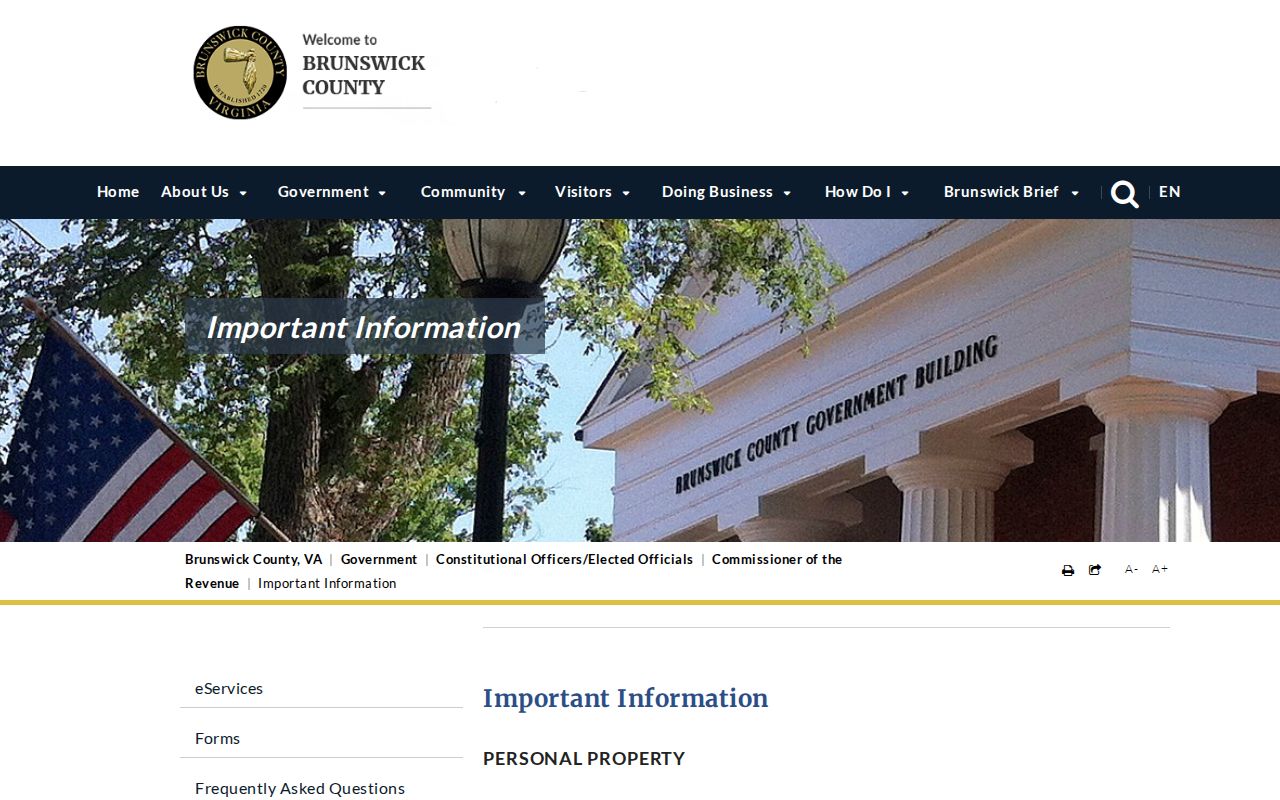
Check the assessment year before comparing a tax record with an earlier bill. Interim construction changes matter just as much when the numbers seem to disagree.
How to Look Up a Brunswick County Tax Bill
The Treasurer's inquiry is the route for bills and payment history. Pick a search mode that matches your source. Name must be entered as printed on the bill. An account number works too. An exact parcel ID works as well. A street name without the house number also works. Parcel searches are sensitive to spaces, and a street search can return several accounts. The result list may page. You may need to switch between Description and Map Number before opening a payment-history or detail view.
- Choose Name, Account Number, Parcel Number or Street Name on the Treasurer inquiry.
- Enter the spelling or parcel format shown on the bill; street search uses the name without a number.
- Review the matching description or map number and select the tax account.
- Open payment history and detail; use the projected-date field for penalty and interest estimates.
- Contact the Treasurer to confirm the current payoff or collection status before acting.
- Assessment
- The Commissioner’s value record used in calculating real-estate tax.
- Tax ticket
- The Treasurer’s account for an amount billed and its payment activity.
- Projected date
- A date input the inquiry uses to estimate penalty and interest.
- January 1 owner
- The ownership snapshot the county uses for that tax year.
Brunswick County Treasurer Search Modes and Results
The county's inquiry help describes each field and the order to use it. Finding a bill and paying one are different steps. The inquiry locates an account and its history. The payment flow asks for an email and can combine tickets. The online route carries a convenience fee that is not refunded. So confirm the total and payment amount before checkout.
| Mode or control | Input | What follows |
|---|---|---|
| Name | Last name; first name optional | Matches the name as it appears on a bill. |
| Parcel number | Tax Parcel ID# with spaces | Opens the matching real-estate account. |
| Street name | Street only, no house number | Can return several tax accounts along a road. |
| Projected date | Date for calculation | Estimates penalty and interest for that date. |
| Payment mode | Department/ticket, parcel or name | Email is entered first; convenience fee may apply. |
Brunswick County Payment History Is a Treasurer Record
The e-Treasurer menu separates inquiry, payment, and yearly paid history. Choosing an account can lead first to payment history. Then it moves to a detail screen. The payment system takes a different path through ticket number, parcel, or name. The detail screen shows whether a ticket was paid. It also shows what balance remains. It covers how a prior year was handled, too. It is no substitute for the deed index. When the question is who owns the land, property records at the Clerk answer it. The county's e-Treasurer menu shows the available inquiry and payment choices.
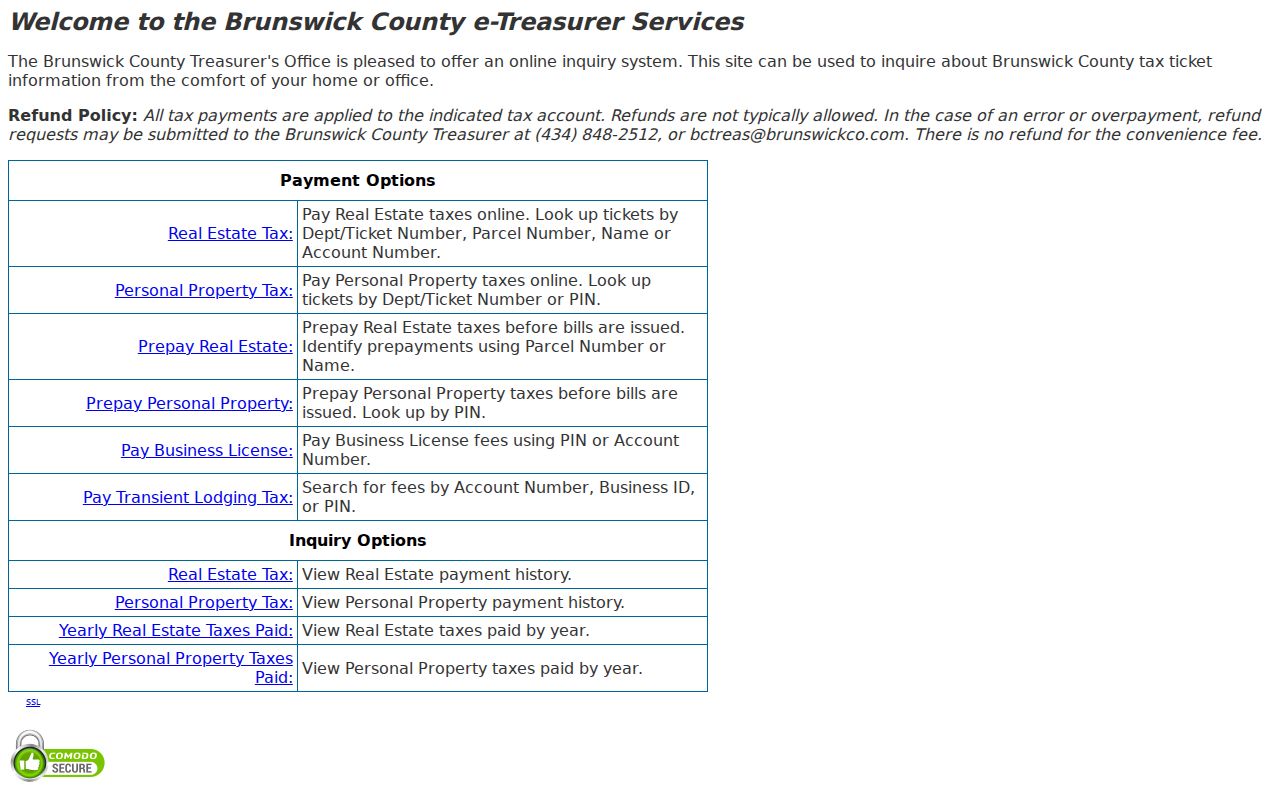
Keep the ticket year and parcel reference with any note. Payment history should never be mistaken for a current assessment. The county's separate Treasurer payment-options page splits real-estate, personal-property, and other tax payment paths. It also offers an inquiry area for paid-history lookups. Follow the prompts for the account. Verify the amount and convenience fee before submitting payment.
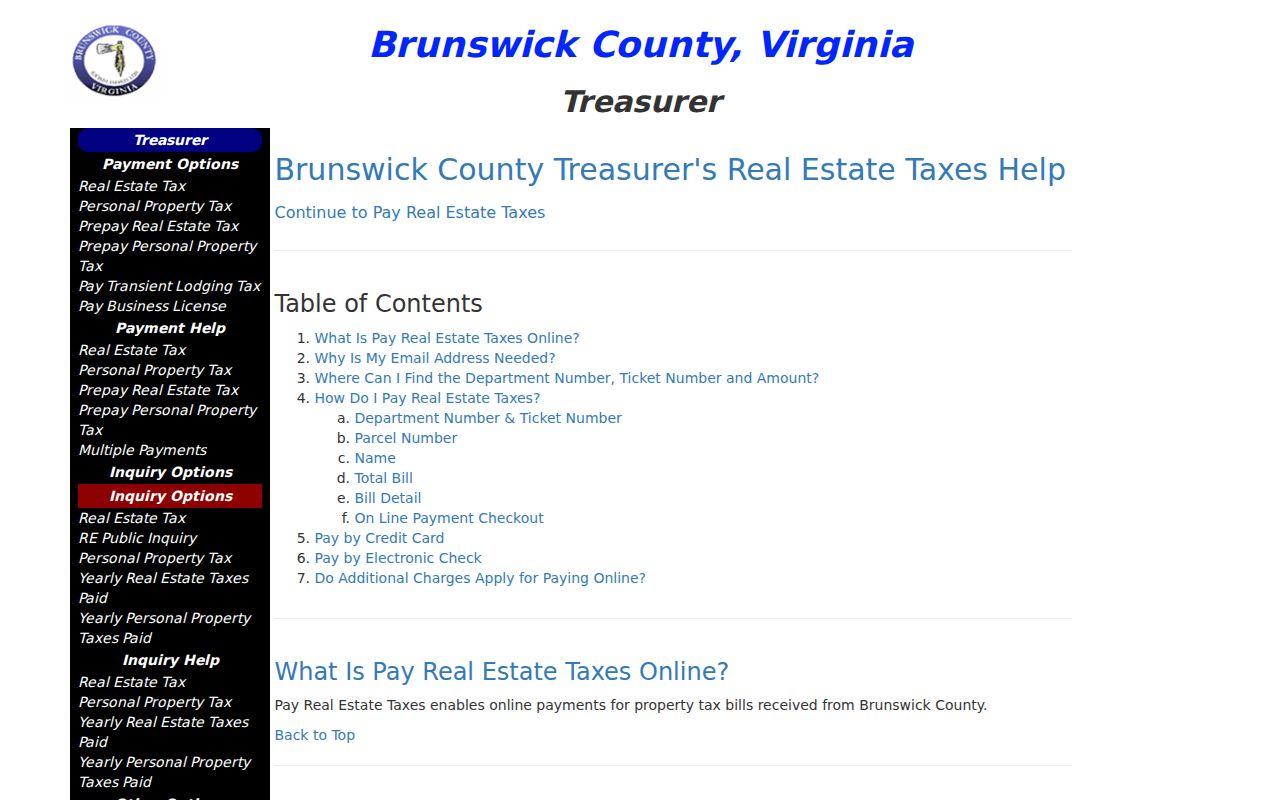
A payment page settles a ticket; the Commissioner's assessment record and the Clerk's deed stay separate property records.
Brunswick County Tax Due Dates and Penalty Estimates
The Treasurer lists December 5 as the annual due date for real-estate and personal-property taxes, subject to the date printed on the bill. The inquiry includes a projected-date control for calculating penalty and interest, and it defaults to the current date. For a true payoff, use the bill and live account. Better still, call the Treasurer. An estimate on an inquiry screen should not replace an official balance from the office. Older public meeting material described a collection sequence after the due date. That schedule is historical context, not a current fee table. Collection fees and procedures can change. Verify the amount and stage with the Treasurer at 434-848-2512 before making a payment or sale decision.
Brunswick County Tax Ownership Starts on January 1
Brunswick County taxes whoever owned the property on January 1. That date controls the whole year. So a buyer whose deed records in March may still find the seller listed on the Commissioner's online roll months later. The Treasurer's ticket can keep showing that same tax account too. None of this changes who actually holds title after closing. It is pure timing.
Before you assume two names means a problem, line up three documents. Check the bill year, the assessment roll date, and the newest recorded deed. Each one carries its own date and its own authority.
Note: Keep the parcel ID and recording references handy when you question either office.
Brunswick County Disabled-Veteran Relief Has Specific Conditions
The Commissioner of the Revenue handles disabled-veteran real-estate tax relief in Brunswick County. To qualify, a veteran generally needs a 100-percent service-connected, permanent-and-total or unemployable status. The property must also be the veteran's primary residence. Pick up the application from the Commissioner's office. Ask there about current documentation. The assessment card alone will not spell out every eligibility rule.
Brunswick County has no land-use program. Keep that in mind when judging agricultural or timber parcels. Rural acreage alone never signals a special-use reduction on the tax roll. The Commissioner can walk you through the current appraisal. The Commissioner can also explain any relief already recorded against the parcel number.
Brunswick County Doublewide Tax Treatment Changed in 2026
A change arrives in January 2026. Per the Commissioner's current information, doublewides will no longer be assessed as real estate. The old treatment in Brunswick County is going away. They may instead fall under personal property assessment. That keeps the real-estate tax rate. The shift can make a familiar structure look different. It shows up when you compare an older property card with a current property search. Confirm the current classification. Ask the Commissioner or Treasurer which account now carries the tax bill.
Do not assume a transfer or a missing structure from a category change. Pull the owner of record roll, the tax ticket and the property-card record. Compare them side by side. Then ask the responsible office how the new treatment applies to that parcel in Brunswick County.
How to Appeal a Brunswick County Assessment
The Commissioner's 2024 public notice laid out a two-stage review. An owner first appealed to the assessor by March 18, 2024. A further appeal to the Board of Equalization could begin April 15. The owner had to show an appraisal error. The assessment might also have failed to conform to market value or equity. Those were 2024 deadlines only. Reassessment dates and appeal windows must be confirmed with the Commissioner. Confirm them for the year at issue.
Prepare before requesting a review. Compare the parcel description and property characteristics against the recorded deed and appraisal. Gather sale evidence. Explain the specific error plainly. The 2024 notice describes mass appraisal built on GIS review and a sales-ratio study. It publishes no future appeal deadline. Contact the Commissioner for the current form, filing method and evidence requirements before acting.
The notice explains that appraisers used GIS to examine parcel lines, topography, open land, woodland and waterfront features. The sales-ratio study measured assessments against market evidence. Those details matter. A useful Brunswick County appeal names the exact parcel characteristic or valuation issue being challenged. A tax-bill balance dispute belongs with the Treasurer instead. An unpaid balance, by itself, never proves the assessed value wrong.
For any Brunswick County property tax appeal, keep the tax year, parcel number and assessment details close at hand. The county's published March and April dates applied to the 2024 notice alone. Confirm the current process, deadlines and submission route with the Commissioner. Do not rely on an older calendar.
Appeal window. The 2024 notice’s March 18 assessor deadline and April 15 Board of Equalization opening are historical examples only. Confirm the current year’s calendar with the Commissioner before filing.